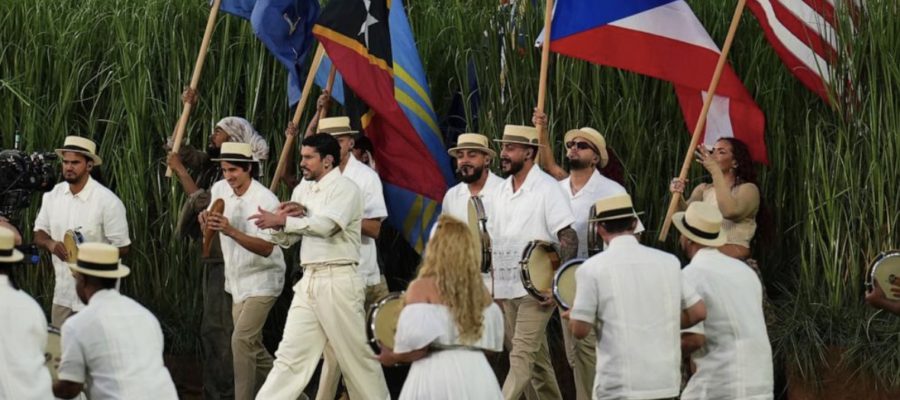
On Sunday, Puerto Rican star Bad Bunny performed at the Super Bowl halftime show. Reactions were largely split across party lines with Democrats touting it as a pro-family, pro-America triumph while Republicans objected to its content or skipped it entirely in favor of Turning Point USA’s All-American Halftime Show.
The choice to feature Bad Bunny (Benito Antonio Martinez Ocasio) was presumably meant to be polarizing. He’s an incredibly successful Spanish speaking star who’s known for his sexualized performances, lyrics, and costumes. Bad Bunny leans heavily into gender bending activism, often appearing in dresses, heels, and sometimes full drag. For many in the conservative camp, this was a bridge too far in a long line of Super Bowl halftime shows that pushed the limits of decency. The Super Bowl has lost their trust over time, and this choice signaled more of the same.

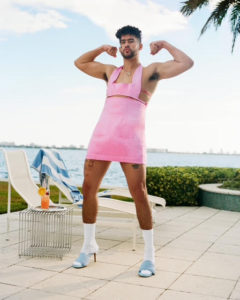


Bad Bunny isn’t just known for his dresses, however. Perhaps more notably, he’s made a name for himself in anti-ICE activism and commentary on immigration/colonialism. He recently chose not to take his tour to the continental United States, expressing a desire to protect fans from ICE enforcement. He routinely displays the light blue Puerto Rican resistance flag in his performances to make a statement- as he did in the Super Bowl. This flag harkens back to a time before U.S. control of Puerto Rico and is often seen as an anti-colonial symbol.
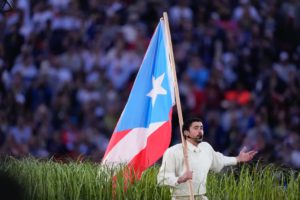
At the Grammys, he echoed the “ICE out” slogan: a call to eliminate or severely limit operations by U.S. Immigration and Customs Enforcement. In the same speech, he controversially grouped himself with undocumented immigrants and referred to them as Americans, stating, “We’re not aliens. We are humans, and we are Americans.”
In a nation sharply divided on immigration, Bad Bunny has become a lightning rod, and the Super Bowl was a proxy war. Fans thought that the show was a celebration of Latin culture. Skeptics were suspicious of a Spanish-only performance by a man who has described white people repeatedly as “gringos” (stating in his Harper’s Bazaar interview: “I highly doubt the type of gringos I don’t f*** with listen to me”) and who has repeatedly expressed his view that Puerto Rico’s relationship with the U.S. is exploitative and colonial and that immigration enforcement is a societal evil.
Opinions on the actual show differ, but what shouldn’t be denied is that it WAS political. The strongest statement was made at the end when Bad Bunny again echoed his sentiment that “America” is defined as the American continents. When he stated “God bless America,” he referred not just to the U.S.A. but to all major countries in the Americas. A parade of flags ended with “Together, We Are America.”
Bad Bunny’s message was at heart a call for open borders, as it always seems to be. The banner emblazoned with “The only thing stronger than hate is love” presumably linked the concept of hate to immigration enforcement and love to a broad view of all countries as interconnected.
My opinion is that while this utopian view is tempting, it’s not realistic. Using Asia as an example, the declaration that “Together, We Are Korea,” would ignore the fact that the difference between South Korea and North Korea is freedom vs. communist oppression.
Bad Bunny consistently treats all Latin nations as a monolith, but they are not. As a Cuban American, my husband does not view his father’s native country in the way some of my Mexican American friends might view Mexico. Life in Cuba was a dangerous and bitter trial under the boot of communism. While the culture is to be cherished, the nation’s degradation is not. His U.S. citizenship is prized. The contrast to his father’s struggle is stark.
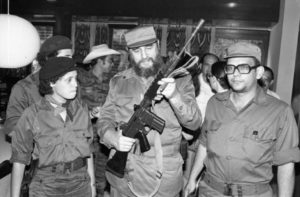 Bad Bunny’s quest to equate all nations and cultures denies the truth that some countries oppress and degrade their people. Rather than addressing these corrupt governments, he seems to view an acknowledgement of their differences as the true degradation. Likewise, he makes no meaningful distinction between citizens of the United States and people residing in its borders illegally. Latino status seems to supersede American status in much of his rhetoric.
For my husband, this is also an affront. He feels that many anti-ICE activists intentionally conflate illegal and legal status to frame anyone Hispanic as legally/illegally interchangeable and anyone who supports immigration enforcement as anti-immigration in general, which is patently false. For every person who enters illegally, people like his grandfather who spent years seeking citizenship while his children lived in Cuba in poverty get bumped further back in line.
My husband expressed it like this: “If your stance is open borders, then you can make a case for it in Congress. Until the laws change, let the government do its job.” As for our family, we believe that enforcing borders is a country’s duty to its citizens. Allowing unvetted immigration is neither kind nor prudent. Every single crime committed by an illegal resident is an avoidable crime, and the families of the victims have a right to demand justice.
The path to citizenship should be available, but it shouldn’t be free of effort. Asylum should be granted for those in need, but it shouldn’t be abused. Only those who love and appreciate this great nation should be granted citizenship.
Stars like Bad Bunny are quick to follow the trend and chant “ICE out,” but they haven’t provided a meaningful alternative. They haven’t answered the questions or solved the problems that illegal immigration creates. Their worldview seems to rely on pretending that these problems either don’t exist or on agreeing to sacrifice some of our citizens for the sake of the ideal.

I’m simply not willing to sacrifice even one Ivory Smith or one Laken Riley (a position that was bipartisan and multi-ethnic a decade ago). You can call it “hate,” but I believe it was and always will be simple common sense.
Thanks for reading, and don't forget to Click here to Subscribe!About the Author

|
Jackie Chea is a blogger from San Antonio, Texas who holds a B.A. in Psychology and an M.A. in Community Counseling from the University of Texas at San Antonio. She writes on political and cultural issues from a conservative, religious standpoint. She lives in the Lone Star State with her husband, Nick, and their 7-year-old son, Lincoln. |

Facebook Comments